AI Fuels My Imagination
During a recent social media “discussion” of the increasing calls to get “screens” out of classrooms, a reader remarked:
When 1:1 came in, it became easier to be less deliberate with what we do because it’s always there and available.
It shouldn’t be a case of “all edtech is great” or “all screen time is bad” – but something in the middle.
While that response may earn a bothsidesism merit badge, the first point is exactly wrong and assumes that laptops just wandered into classrooms.
First of all, built on a coherent vision of computing and learner-centered education, 1:1 computing was about flexibility, choice, convenience, agency, and kid power. When the first schools in the world embraced a laptop for every child in 1989-90, their ambitions were rooted in progressive education traditions and inspired by Seymour Papert and Cynthia’s 1971 vision of every child owning a personal computer that could be used for learning “anywhere, anytime.” I use a computer whenever and where ever I choose to. In fact, I’m writing this in an airport lounge at O’Hare hopped up on jetlag and Apple Jacks. Oddly, the personal nature of “personal computer” (PC) seems to elude a great many teachers, administrators, and parents.
When you add the computational making potential afforded by collaborating with generative AI chatbots you supercharge the breadth, depth, and range of possible projects. The seemingly impossible becomes possible.
This is true for adults and developmentally appropriate for even young children.
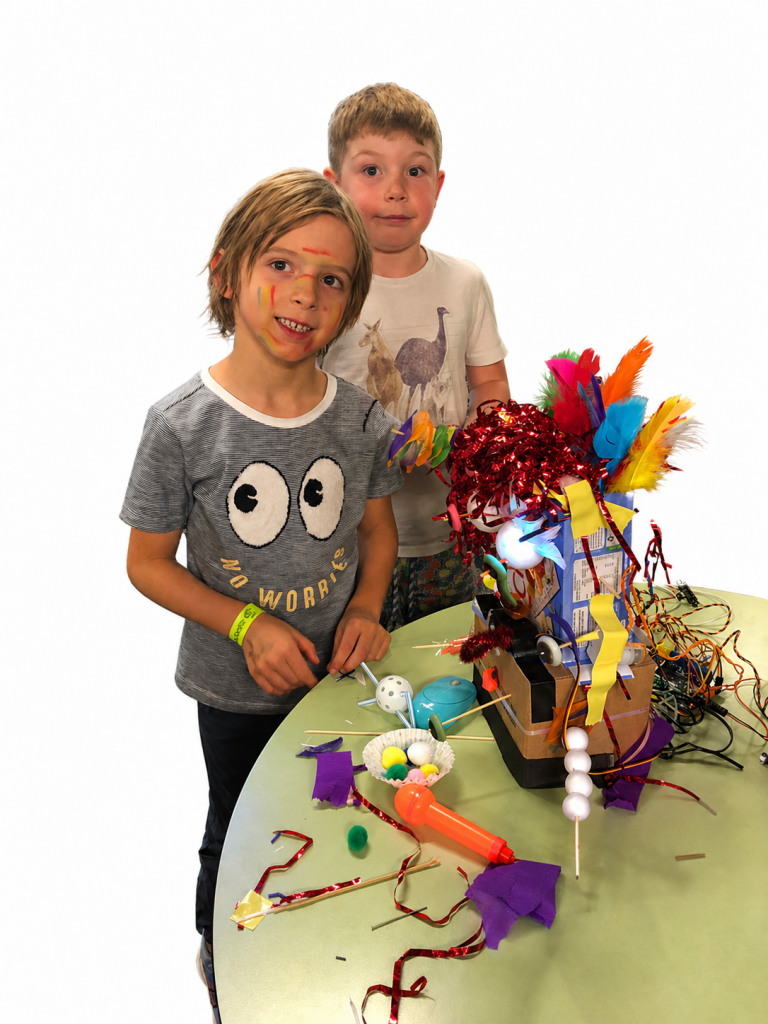
If you are comfortable with a six year-old making a dinosaur out of cereal boxes, why would you object to the same child making a cereal box dinosaur that now can sing, dance, tell jokes, give a weather forecast, or send a text message to your grandmother? If you make simple things easy to do, you make complexity possible.
I’ve been making things with computers for fifty years and did something last night that blew my mind.
“Any sufficiently advanced technology is indistinguishable from magic.”
Arthur C. Clarke
Computational Making
For the past couple of years, I’ve been using ChatGPT, Claude, Descript, Authory, and a few other AI software environments as a collaborator, researcher, editor, co-designer, illustrator, mentor, apprentice, and employee. I published Ken Kahn’s fantastic book, The Learner’s Apprentice: AI and the Amplification of Human Creativity. I shared Brett Moller’s white paper about how he designed an app for managing an elaborate student field trip in remarkable ways. Over the past six months, I have been using Claude Code to create a WordPress plugin that will allow the Papert archives I maintain to serve scholars well into the future (public announcement coming soon).
Next, I created a database to add the functionality that Apple Music ignored. I can now query my 3,000+ CD collection to find all the recordings on which Ron Carter and Billy Hart perform or identify glaring omissions in my collection of Freddie Hubbard recordings. With the help of AI, I have added functionality to my computer’s operating system to convert file formats or edit images with one click.
These projects are not as sexy as raising test scores by a decile or catching plagiarism, but I have not regretted a second of the hundreds of hours invested in learning and making with the chatbots. Tasks that were impossible a few months ago are now possible.
The world is awash in data and yet Apple and Microsoft are doing very little to leverage it for users. (Don’t even get me started about the state of operating systems or how engineers have been deployed to make dancing poop Genmojis rather than add “intelligence” to the system and making life easier for users.)
These nascent AI tools allow me, a hobbyist programmer, to design and deploy software with one customer – me. AI makes it possible create software for one, even software for once.
About Last Night
While eating dinner, watching TV, and packing for several upcoming trips, I found myself “messing about” with Claude Code. My lack of sleep and stress level undoubtedly led me to blow off some steam tinkering. In the late 1980s, a genius friend of mine, Brian Silverman, wrote a small book, The Phantom Fishtank, explaining his playful rules for building complex systems on the frontiers of science and mathematics using cellular automata. That book was accompanied by Apple II software that not only demonstrated the author’s experiments, but enabled readers/users/scientists to run their own. Despite there being very little market for such software, my friend’s work continues to be cited by scientists. The playfulness and whimsy of my brilliant colleague made otherwise post-doctoral experiments fascinating to those of us who barely understood what was going on. He created a microworld in which we could explore powerful ideas within our zone of proximal development but with an infinite horizon.
Last night, I uploaded a PDF copy of my friend’s book and asked Claude Code if it could create a web-based version of the software. A minute or two later, I had working software. I made a few cosmetic tweaks to it and even asked for Claude to write a manual for the new software. It did a fantastic job. By the way, the software and manual made by Claude credited the original author. Please understand that I created polished, professional quality, open-ended software with a modern user interface that runs in any browser. 🤯
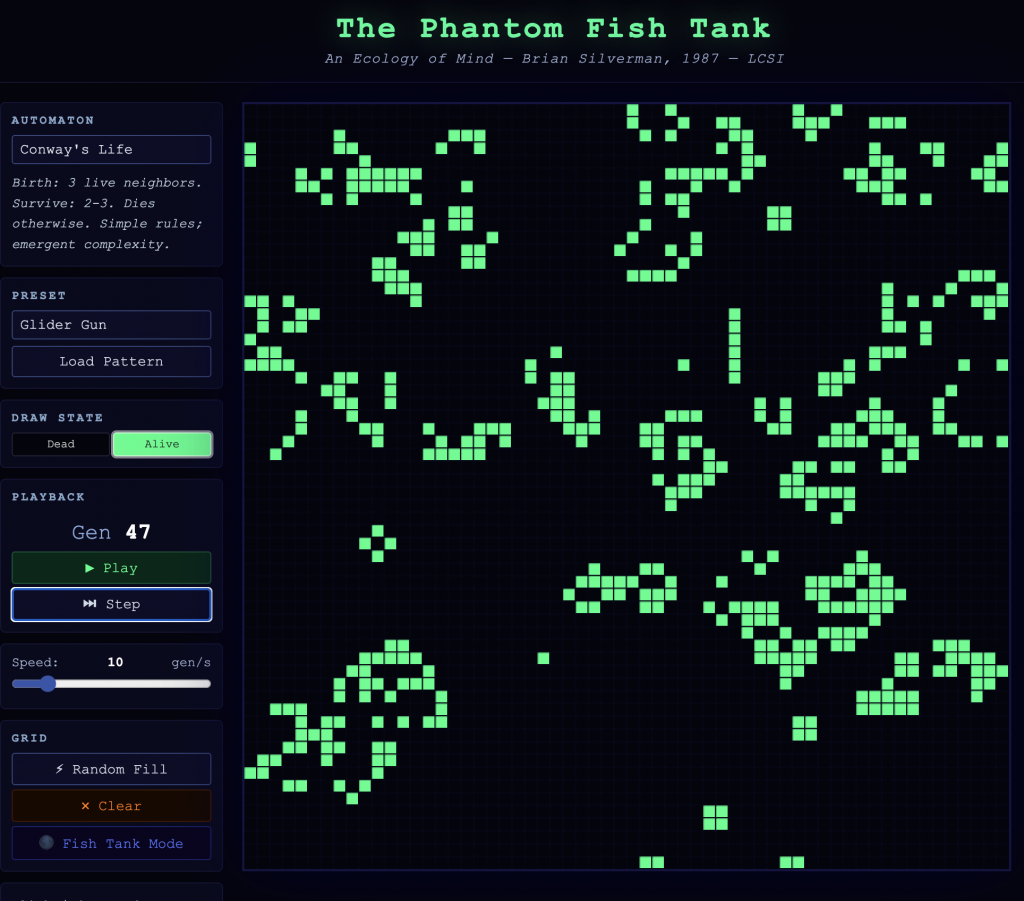
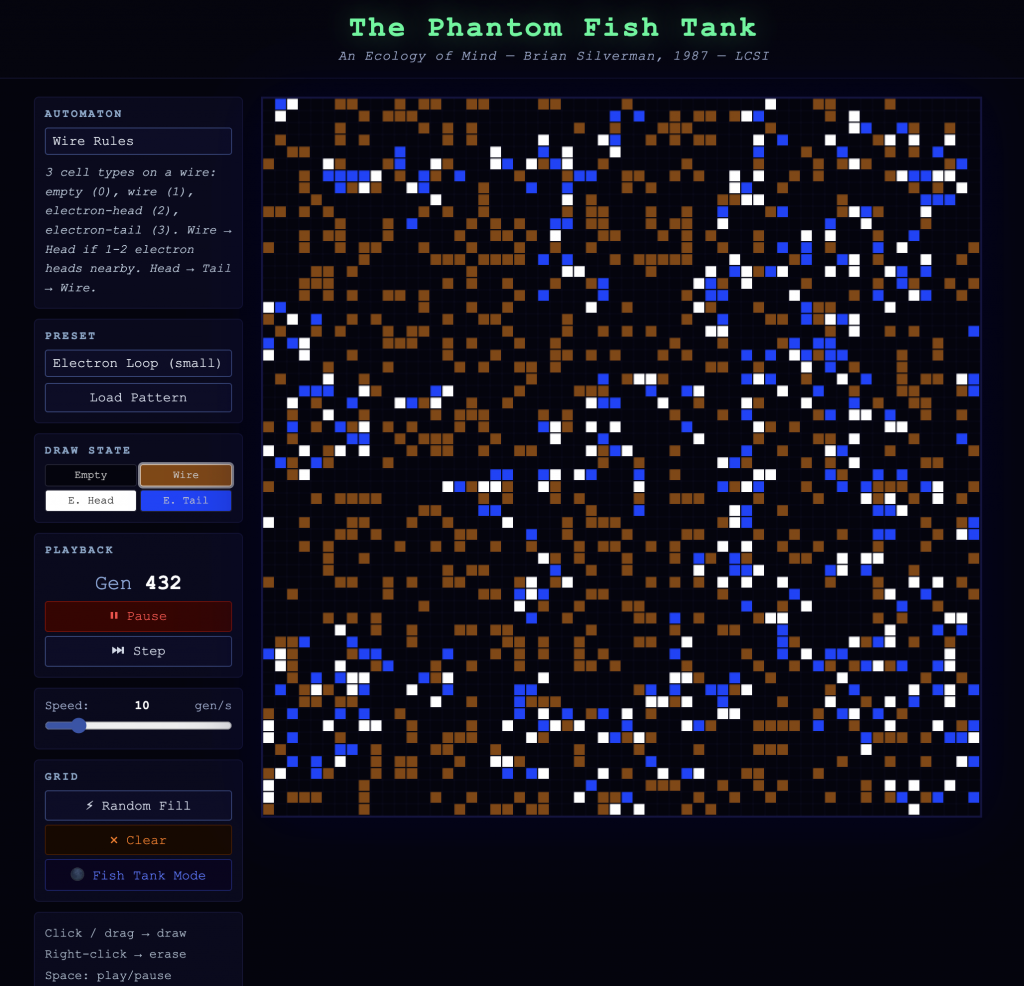
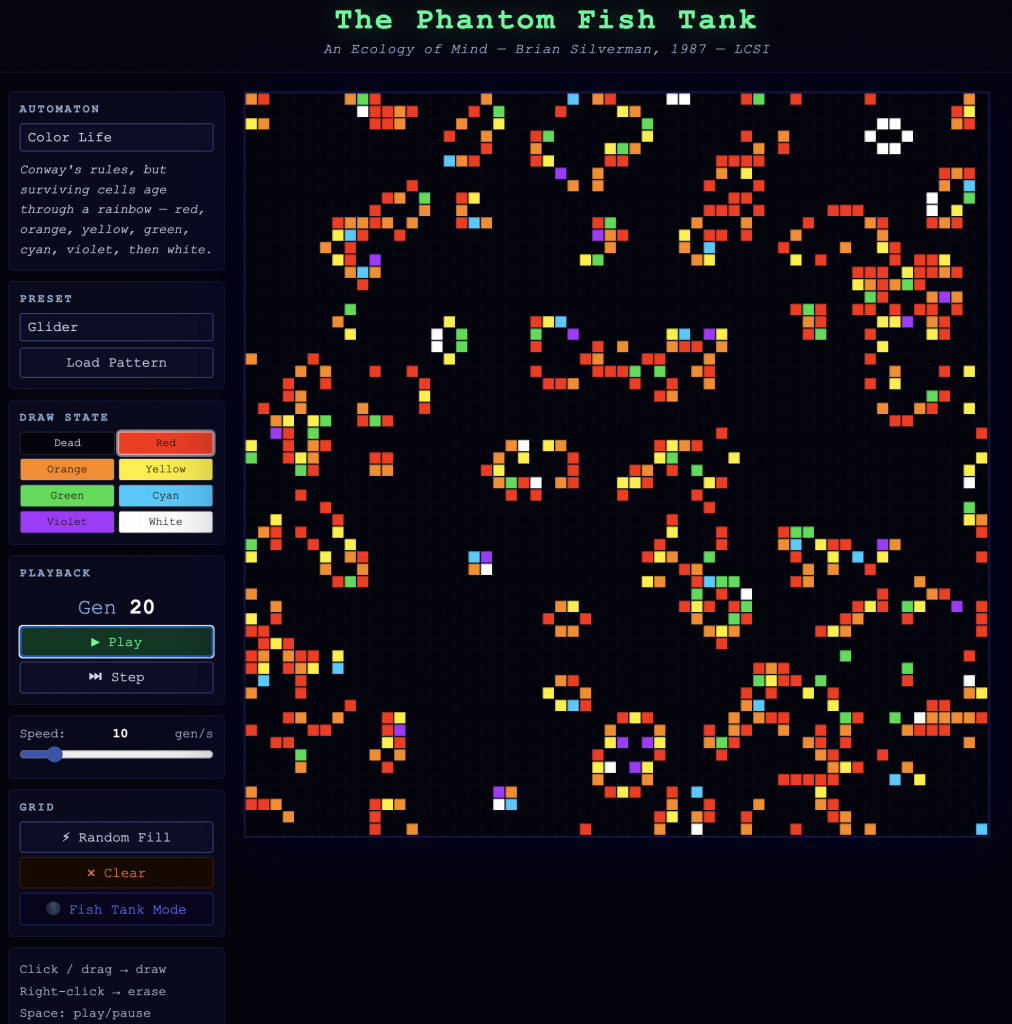
Most people who know Brian consider him an extraordinary software engineer. He had a hand in nearly every microcomputer version of Logo, created Turtle Art (with Paula Bonta), led the development of LogoWriter, MicroWorlds, LEGO TC Logo, and played a major role in the creation of Scratch, Scratch Jr., and Octostudio. Brian is an MIT graduate who does things for fun like launching his own satellite or building a computer out of Tinkertoys (or here). With the help of a chatbot, I was able to bring one of his great software creations back to life, in just a few minutes, nearly forty years after Brian first invented the software.
Run the AI-generated version of Brian Silverman’s Phantom Fishtank software here. The “manual” may be found here.
So?
“Making” this software was neither cheating or a mindless pursuit. Each success collaborating with AI, no matter how small, sends my imagination into overdrive thinking about what I can learn, make, and share next. It has lubricated my mind. I frequently finding myself writing computer programs and writing prose simultaneously, continuously switching between tabs literally and in my head. What’s most surprising about this “multi-tasking” is its intensity and ability to sustain my attention. I find myself working longer and producing greater output with AI than ever before. Imagine what might grow out of the fertile imagination of children using these computational materials.
Over the past half century of microcomputers, there is no longer a viable business model for designing high quality, creative, open-ended software for learners. Upon reflection, the number of software titles that excited me and offered extended play value to kids can be counted on my fingers. That means that as software companies disappear and new operating systems emerge, neither the kids I teach or my grandkids will enjoy the benefit of the computational magic that inspired such rich learning adventures for decades.
I am optimistic that working with generative AI, I will be able to make constructionist software environments for the next generation of learners without being dependent on companies that may or may not exist. For example, there is no good reason that Hypercard no longer exists, even though it was the design software for the iPad before there were iPads. Now that the software engineering process has been democratized, I can’t wait to share what I invent next!