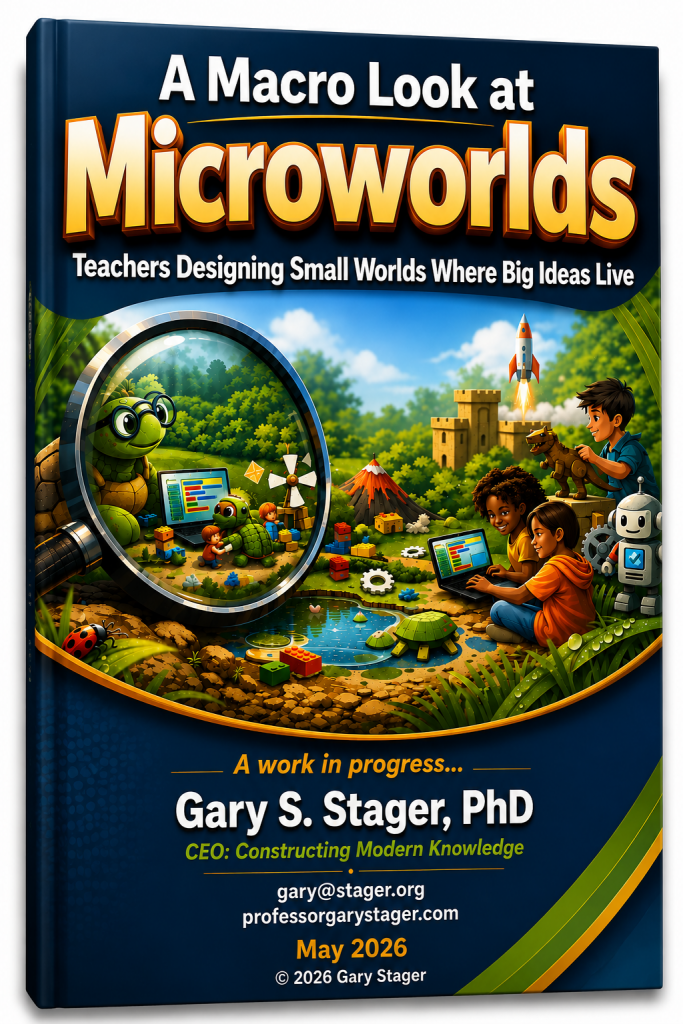
A Macro Look at Microworlds (working paper)
I just released a new working paper titled “A Macro Look at Microworlds: Teachers Designing Small Worlds Where Big Ideas Live,” and I would love for you to take a look. This project is borne of a career-long belief that educational technology is at its most powerful when it moves away from “delivery” and toward “construction.” The document is a working paper because I continue to find ideas worth incorporating. (someday)
There’s even a one-page executive summary (written by my AI colleague) for those of you afraid of a few pages. 😎
For too long, the concept of the microworld—first articulated at MIT’s AI Lab and popularized by Seymour Papert—has been one of education’s most underutilized ideas. In this paper, I argue that we need to put teachers back in the driver’s seat. Instead of relying on one-size-fits-all software from vendors, we can curate “computational ateliers” where children act as mathematicians, poets, and artists through exploration and discovery. The timeless idea of microworlds is a perfect way to realize Jerome Bruner’s admonition, “any subject can be taught effectively in some intellectually honest form to any child at any stage of development.”
In the paper, I explore:
- The Roots of the Tradition: How microworlds rest on a constructionist foundation where knowledge is built, not transmitted.
- The Reggio Emilia Connection: Viewing the computational environment as a “third teacher” that communicates respect for a child’s capability and supports tinkering.
- Practical “Monday Morning” Tools: I’ve included three hands-on tutorials and practitioner handouts for using Snap!, Finch robots, and Turtle Art in your own classroom.
Whether you are interested in the relationship between angle and form in geometry or the way a word-action world can support early literacy, this document is meant to be both a manifesto and a starter kit. My goal is to provide the theoretical grounding you need to defend this pedagogy in your school and the concrete tools to start building your own microworlds immediately.
You can download the full working paper for free here. I look forward to hearing how you use these ideas to plant the seeds for big ideas in your own “small worlds”.