Time to Make Something WITH AI
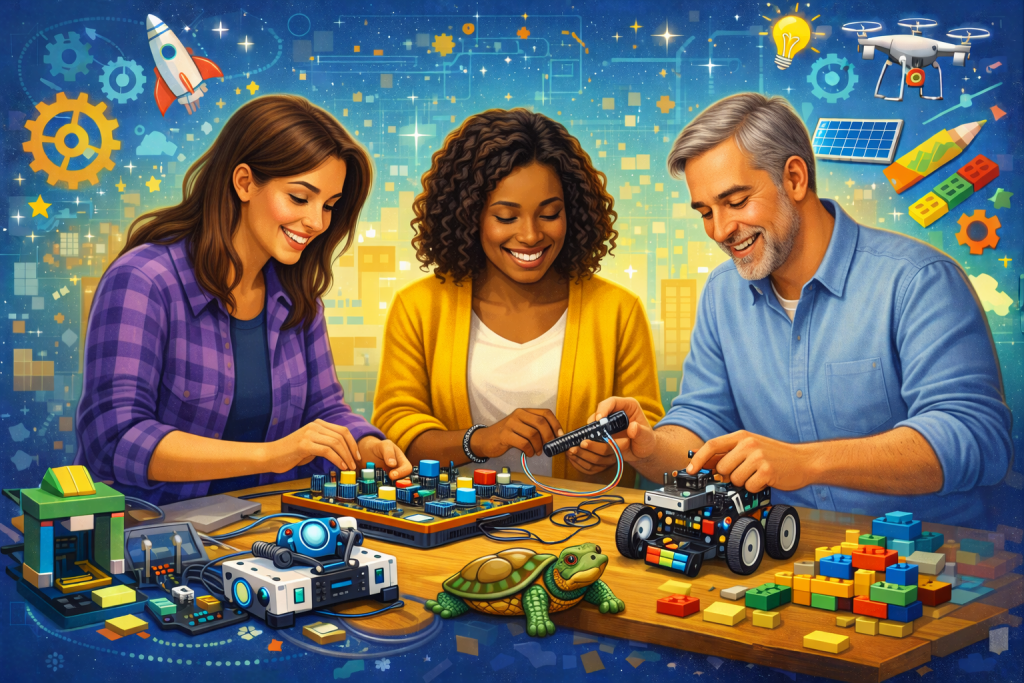
Yesterday, I led a new workshop, Computational Making & Learning, for the first time in Melbourne, Australia. Although there is always room for improvement, the workshop was a great success. I made the case for learning-by-doing, explored how computation can supercharge project-based learning, revisited the pedagogical power of teacher-created microworlds in Turtle Art, SNAP!, and with Finch robots, and created opportunities to employ generative AI chatbots as a collaborator in creating software. The day culminated with a demonstration of the wildly powerful Wolfram Notebook Assistant + LLM Kit as a window onto an incredible computational future.
After hands-on computational experiences in Turtle Art, SNAP! and with the Finch robots, the largest project time was reserved for creating computer games. Decades of experience creating constructionist learning environments where learners of all ages successfully create mind-blowing projects free of coercion or instruction gave me the courage to bet on teachers and chatbots.
If I asked teachers to work with AI to create working, interactive, attractive, and fun games, I was reasonably confident they would succeed. They sure did not disappoint. Each workshop participant produced a fully operational game in under an hour. All sorts of learning was evident.
I suppose I should have collected their programs to share with you as evidence of the workshop’s success, but I find that it’s best not to share prior “student” projects as examples because they are often intimidating or interpreted as “the right answer.” That said, I did provide some inspiration to prime the creativity pump. Now, you can replicate the experience with your students.
Back to the Future
I was blessed to learn to program computers for the first time around 1975 at Schuyler Colfax Jr. High School in Wayne, NJ where Mr. Jones taught every 7th grader to program computers, five days a week, for nine weeks. This was not vocational, gifted & talented education, or an elective. It was in the rotation between learning to make a tie rack and bake a soufflé. My otherwise ordinary suburban school district introduced computing (as a verb) to students around 1962-64. Thanks to Mr. Jones, I felt intelligent, creative, and competent for the first time. I then spent the better part of the rest of my schooling programming computers, challenging my peers, and teaching others to program. (Read more about this experience here)
For several years, my peers and I never encountered software written by someone we didn’t know. Software was something you made.
Computer programming was a recreational activity. In fact, there were publications, like Creative Computing Magazine and Compute!, that served as inspiration to a far-flung community of recreational programmers. David Ahl, publisher of Creative Computing, told me decades later that at its apex (c. 1984), the magazine had 400,000 subscribers. Can you imagine that? In 1984?
My four decades of advocating for personal computing across the curriculum is rooted in the hard fun of that era. One of my longtime classroom rules has been, “You can play any game you write.”
I often wondered under what conditions could recreational programming make a comeback. The maker movement was cause for hope that was never realized when fabrication became the focus. The widespread availability of AI chatbots is the best chance ever for democratizing computational making and recreational programming.
Thanks to the Internet Archive and some good old-fashioned AI collaboration, I created a handbook for my workshop participants. (link below) It features twenty timeless game ideas, plus one I contributed. Of course, my workshop participants were free to use the handbook as inspiration or come up with their own ideas.
The prompt for my “students” was simply, Ask a chatbot to create a web app game that would ______
The freshly minted software designers then described what they wanted their “app” to do – rules of the game, interface features, goals, etc… The process was of course generative – try something, check the work, debug, embellish, improve… It’s a great application of the Think-Make-Improve (TMI) paradigm described in Invent To Learn. Asking for a “web app” ensures that the software will run in any browser, either locally or if stored on a server.
Happy to Share the Handbook with You
The eBook I created is predicated on a foundation of progressive education ideals (especially constructionism), a belief that projects should be the smallest unit of a teacher’s concern, a recognition that the future is computational, and awareness that artificial intelligence (AI) may be used to supercharge the range, breadth, and depth of possible student projects.

In our book, Invent To Learn – Making, Tinkering, and Engineering in the Classroom, we make the case for the value of learning-by-making, a timeless idea ushered into modernity by Seymour Papert, Cynthia Solomon, and their colleagues.
The effective implementation of such project-based-learning begins with teacher curiosity, generosity, ingenuity, and respect for children, starting with high-quality prompt setting, an embrace of generative design, and affection for serendipity.
One need not approach artificial intelligence with ecstatic dreams or dystopian terror. Fundamentally, generative AI is just software. As Ken Kahn demonstrates so clearly in his book, The Learner’s Apprentice – AI and the Amplification of Human Creativity, artificial intelligence can be a simultaneous mentor and apprentice that allows even young children to solve problems their teachers have never anticipated.

The popular modern “maker movement” blessed all of us with greater ability to make things with bits and atoms. With fabrication technology, we can now make all sorts of wondrous tangible objects with speed, thrift, and precision. With code we can make things too AND add interactivity and intelligence to physical artifacts. Sadly, schools have once again left bits behind in favor of cutting up cardboard and pool noodles. That is largely the result of adults’ fear and ignorance of the empowerment associated with programming.
Mathematician, software developer, and MacArthur Genius Dr. Stephen Wolfram agrees that the future is computational. “For any discipline X, there is now or soon will be a branch of that discipline called Computational X.” This represents not only the more interesting (and often playful) frontier of that discipline, but the better paying segment of it as well. Powerful new block-based programming languages and AI chatbots lower the barriers to democratizing computing allowing anyone to create software – even if they are the only customer for it.
All of this adds up to the modern realization of an ideal held during the early days of artificial intelligence research at places like MIT where in the late 1960s – early 1970s, AI research was deeply concerned with children, Piaget, and computational making. In fact, an unofficial slogan of the MIT AI Lab was “Computers are for children.” Read more here. (https://reggio.constructingmodernknowledge.com/roots)
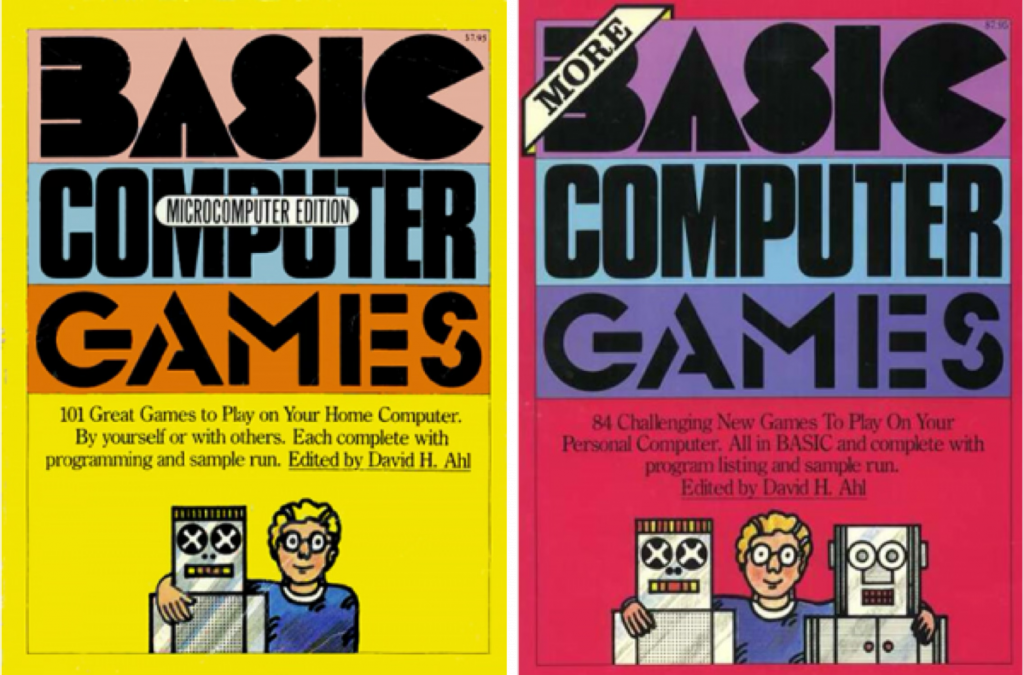
That full circle phenomenon brings us to this “project.” In 1973, David Ahl wrote a collection of games in the BASIC programming language and distributed mimeographed copies to recreational computing enthusiasts far and wide. Major hardware companies featured versions of these games on their systems, in 1978, the first commercially published version of the book, BASIC Computer Games (PDF copy of book) was published. It was the first computer book to ever sell over 1 million copies. Think about that, nearly 50 years ago, a computing book for hobbyist programmers sold a million copies.
We share summarized ideas from that book as inspiration for children and teachers alike to collaborate with AI chatbots and “make” their own computer games. Go ahead and make a game! Share it with your friends! You may be surprised by what you learn and can do with a little help from your peers and artificial intelligence.
References
Hansen, S. (Host). (2024, May 29). What’s worth making? [Audio podcast episode]. In Chalk Radio. MIT OpenCourseWare. https://chalk-radio.simplecast.com/episodes/whats-worth-making-with-prof-hal-abelson
Kahn, K. (2025). The learner’s apprentice: AI and the amplification of human creativity. Constructing Modern Knowledge Press.
Martinez, S. L., & Stager, G. S. (2013). Invent to learn: Making, tinkering, and engineering in the classroom. Constructing Modern Knowledge Press.
Papert, S. (1980). Mindstorms: Children, computers, and powerful ideas. Basic Books.
Papert, S. (1993). The children’s machine: Rethinking school in the age of the computer. Basic Books.
Papert, S., & Solomon, C. (1971). Twenty things to do with a computer (Artificial Intelligence Memo No. 248). MIT Artificial Intelligence Laboratory. https://dspace.mit.edu/bitstream/handle/1721.1/5836/AIM-248.pdf?sequence=2
Solomon, C. (1986). Computer environments for children: A reflection on theories of learning and education. MIT Press.
Stager. G.S. (2025) Our roots: Logo, Piaget, and AI. https://reggio.constructingmodernknowledge.com/roots
Stager, G. S. (Ed.). (2022). Twenty things to do with a computer forward 50: Future visions of education inspired by Seymour Papert and Cynthia Solomon’s seminal work. Constructing Modern Knowledge Press.
Wikipedia contributors. (2025). BASIC Computer Games. Wikipedia. https://en.wikipedia.org/wiki/BASIC_Computer_Games
Wolfram, S. (2016, September 7). How to teach computational thinking. Stephen Wolfram Writings. https://writings.stephenwolfram.com/2016/09/how-to-teach-computational-thinking/