How Do Giraffes Sleep? The Evolution of Knowledge Democratization
In his profound essay, Obsolete Skill Set: The 3 Rs — Literacy and Letteracy in the Media Ages (1993), Seymour Papert made a distinction between literacy and letteracy, as a way to think about the evolution of knowledge acquisition. Papert argued that being able to read and write may be a barrier to learning that may be overcome by new technology. He was gifted in helping lay people understand complex issues through storytelling.
For decades beginning in the 1980s, Papert used one tale as a vehicle for thinking about new opportunities for knowledge construction while reducing reliance on decoding skills.
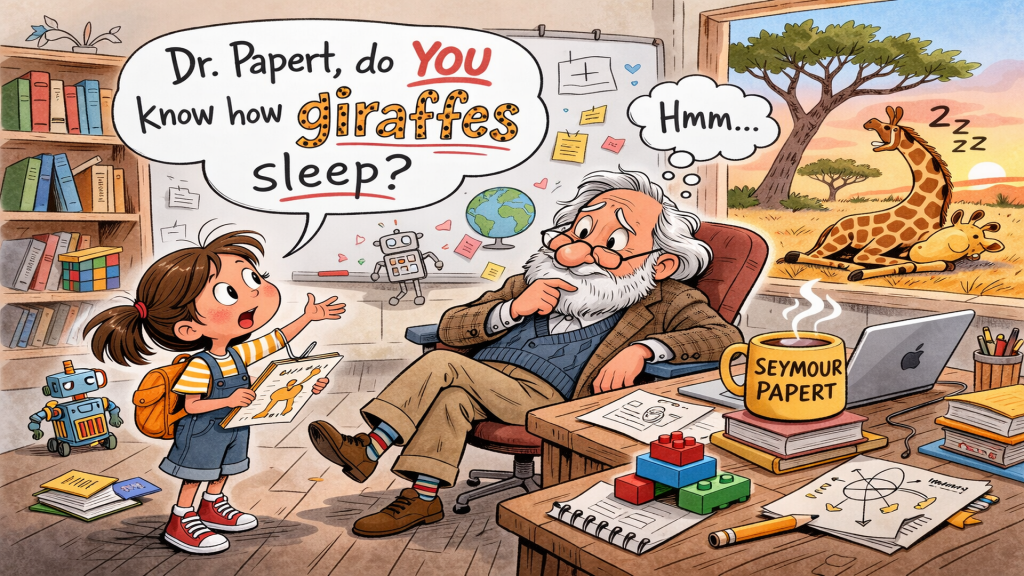
Seymour met a four-year-old girl who had a question for him. She heard he was born in Africa and wanted to know, “How do giraffes sleep?” Dr. Papert didn’t know the answer to her question, but he thought it was important to help. As a distinguished MIT Professor and adult, he figured he could get an answer. It would not be hard for him to find a zoologist, pick up the phone, call, and ask how giraffes sleep. He might need to call several scientists, but eventually, he might find an answer.
The four-year-old girl has neither Papert’s social capital, phone access, or Rolodex. The only hope she has for answering such a question is to stumble upon an adult possessing knowledge of how giraffes sleep. If a giraffe expert doesn’t come to dinner, she’s out of luck.
Dismissing a child’s curiosity or curtailing her ability to answer a question, no matter how seemingly child-like, is indefensible and disrespective. This is the case even if you harbor personal antipathy towards artificial intelligence or other emerging technology. If you make simple things easy to do, you make complexity possible.
How can any adult be content with a child’s question going unanswered when vehicles for knowledge construction are otherwise ubiquitous? There are countless opportunities to point a phone at something and ask “AI” to tell you about it today. One can learn so much and so deeply, even before developing what school calls reading and writing. Such a simple act of personal curiosity and agency is a gateway to a lifetime of learning. Freedom supercharges learning.
Back to Giraffes
Papert continuously updated this parable with each generation of information technology.
Telephone
Action: Call an expert
Pro: If you find a giraffe expert, you can quickly to get an answer.
Con: Toddlers don’t know giraffe experts, have a phone, or know the phone numbers of Zoologists.
CD-ROM
Action: Pop in a CD-ROM encyclopedia and search
Pro: Simple
Con: The CD-ROM has space limitations and if the publishers didn’t include how giraffes sleep, for whatever reason, you’re out of luck. Physical media.
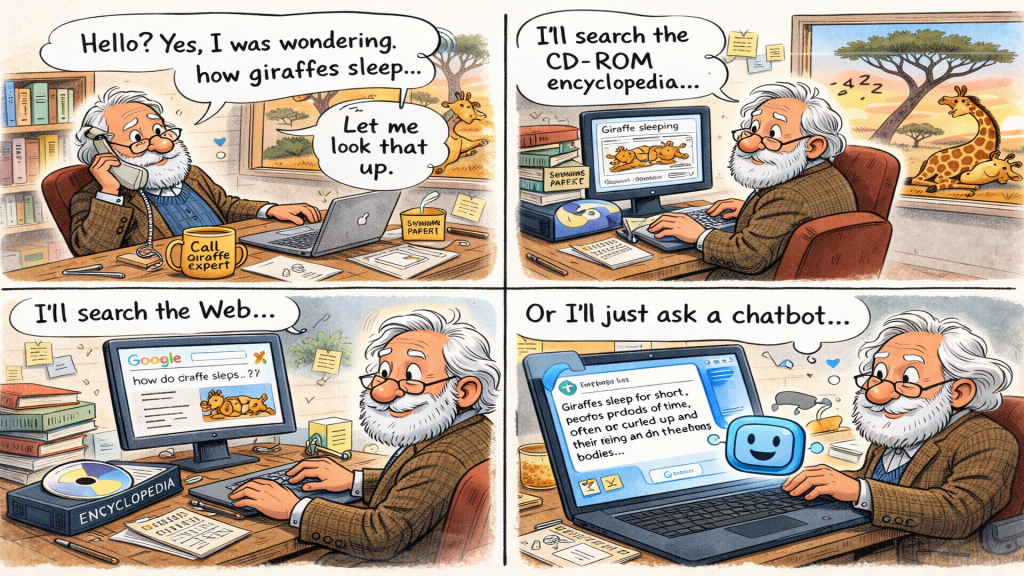
Web
Action: Search the World Wide Web looking for an answer
Pro: Simple, free, browser based
Con: Someone needed to create a web page explaining how giraffes sleep, otherwise you’re out of luck.
Social Media
Action: Ask a social network or listserv your question
Pro: Free and if you find the right community, your answer might be answered quickly
Con: Childhood access to social media, social media, no guarantee you will find your answer
Generative AI
Action: Ask a chatbot, “How do giraffe’s sleep.”
Pro: Might receive a quick answer to your question, multimodal (a kid can talk to the chatbot with being letterate), once you answer the question, there may be many more questions to wonder about or pursue.
Con: Minor risk of inaccurate information. That’s why you should always ask, “How do you know?” or “Provide evidence” or “Show citations.”
Papert’s Giraffe Story Evolved Over Time
(1991) Keynote Address NECC June 1991
(1991) Keynote Address — Kids and Computer: What’s a Parent to Do? — MIT, September 1991
(1993) Obsolete Skill Set: The 3 Rs Literacy and Letteracy in the Media Ages
(1993) The Children’s Machine: Rethinking School in the Age of the Computer
(1996) Children & Learning in the Computer Age
(1996) Bridging the Digital Generation Gap