Educating is a Political Act
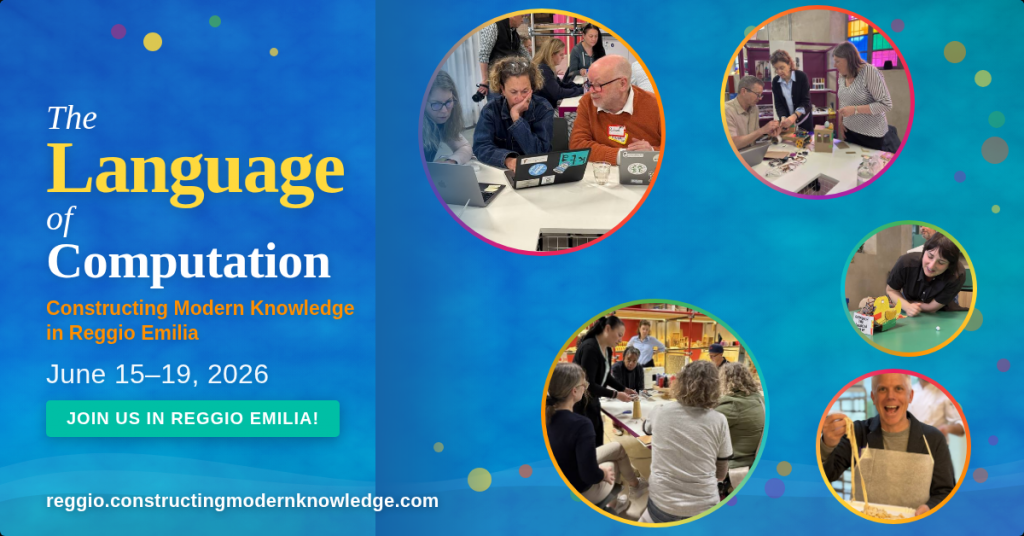
The following is a newspaper editorial authored by the President of Fondazione Reggio Children (translated into English). It was published mere weeks before our institute, The Language of Computation – Constructing Modern Knowledge in Reggio Emilia. (a few spots are still available)
Educating is a Political Act
by Francisco Profumo
School is one of the great democratic infrastructures of our society
On the morning of May 13, in Reggio Emilia, when the Princess of Wales met boys and girls, teachers, atelierists, researchers and educational communities of the Reggio Emilia Approach, something profound materialized.The international recognition of the fact that education is today one of the great political issues of our time. Not “educational policies” in the administrative sense of the term, but politics in its original and higher meaning: building the conditions of civil coexistence.
In an era marked by wars, polarizations, aggressive languages and growing social fragmentation, education is one of the few tools capable of generating cohesion.
This is why I believe that today we must have the courage to affirm a seemingly simple, but deeply radical thesis: educating is a political, non-violent act of peace. Education is a political act because it forms people capable of living together in complexity, welcoming difference as a wealth, without turning it into conflict. Because dialogue teaches, instead of the overwhelm that we witness in the highest systems. Because it builds citizens, and not simply competing individuals.
In recent years we have witnessed a profound transformation of public space. Social networks have accelerated the speed of reactions, reduced the time of reflection, amplified radicalization. Political and social communication has progressively shifted towards emotional and conflicting registers. Even young people grow up immersed in an ecosystem that pushes towards simplification, polarization, immediacy and continuous performance.
Within this scenario, the school risks being perceived only as a place of evaluation, selection and technical preparation for work. But if we reduce it to this, we lose its most important function.
The school is one of the last great democratic infrastructures of our societies. It is the place where a community decides that the future cannot be left to chance or to the initial inequalities.Every day, in schools, a silent but decisive job is done: we learn to listen, to collaborate, to respect, to discuss without destroying, to live between differences. They are apparently ordinary gestures.In reality they are the democratic antibodies of a society. A school principal is not just an efficient administrator. He is a community builder. It is the person who must create the conditions for a school to become a place of trust, mutual growth, human innovation even before technological.In the same way, every time a teacher values the word of a fragile student, who chooses to accompany, to include, to build trust, he builds not only knowledge, but the way in which a society learns to be together. And that is why leaders and teachers are today, perhaps more than in the past, decisive figures for the democratic quality of our communities.
Experiences like that of the Reggio Emilia Approach then take on an international meaning that goes beyond the pedagogy of childhood. The world looks to Reggio Emilia because there has developed an idea of education based on relationship, listening, creativity and recognition of the dignity of boys and girls as citizens from the beginning of life. Loris Malaguzzi was talking about children’s “one hundred languages”. That intuition appears even more modern today. Because in the age of artificial intelligence the biggest risk is not only technological. It’s anthropological.
Artificial intelligence will profoundly change work, production and access to knowledge. But precisely for this reason the value of the most human skills will increase: listening, empathy, critical thinking, the ability to cooperate, responsibility towards others. That’s why education will be the real political ground of the 21st century.
There will be no stable democracy without strong educational communities, nor sustainable innovation without critical culture. There will be no social cohesion without schools capable of generating belonging. Perhaps this is also what Princess Kate’s visit symbolically recognized: that the future of contemporary societies is played out long before universities, markets and institutional politics. It is played in places where children learn to look at the world and others. Places that are lacking in many contexts and for which there is a maximum need. In the time of smart machines, the real challenge will be to remain human. And education will remain the most powerful nonviolent political act that a society can perform.
Francisco Profumo
President of Fondazione Reggio Children
May 22, 2026
Source:
Profumo, F. (2026, 2026/05/22). Educare è un atto politico. Corriere Della Sera. https://www.corriere.it/opinioni/26_maggio_22/educare-e-un-atto-politico-8a22c14f-d58c-4a60-b3cf-807949c16xlk.shtml